
The Three Grünewalds
You were expecting three kings? Nope, you get Army and Art today.

(Before we start, I’ll admit that I do not know how to convert my keyboard to access German umlauts. Nor do I care to learn. From here on out, Grünewald becomes Gruenewald, a valid English version. So there.)
My first duty station in the Army was Berlin, Germany, 1992. I couldn’t believe my luck. I was supposed to go to Fort Bragg, but a sudden opening meant they needed an experienced new Army attorney in the Berlin Brigade. I was thirty and just coming off of five years in the courtroom. Definitely in the right place at the right time.
After three months of training in Fort Eustis, VA and Charlottesville JAG School at the University of Virginia, I was finally ready to fly solo into the new job. I arrived and my sponsor picked me up at the airport in her huge four wheel drive. She chattered happily while driving along at what seemed like a grotesquely fast speed - I was an autobahn novice - and flipped through the German radio stations. All of them seemed stuck in some parallel universe - I have a vivid memory of hearing Everybody Was Kung Fu Fighting, which had been popular stateside in 1974.
I had dinner with my sponsor and her husband at their house offpost. As we reached the destination, she whipped the steering wheel and bumped up the front and back right tires onto the curb and sidewalk. She laughed when she saw my face - apparently this is how you park in German neighborhoods in Berlin so a car can drive down the middle. I just wanted to go to bed - I’d gotten zero sleep on the flight - but she insisted on keeping me awake until at least eight, then drove me to my room at the Harnack House, promising to pick me up for PT the next morning.
Really? REALLY? Don’t I get even one rest day to recover from jet lag? Umm, no. So I set my alarm clock and got up early to wash my hair and make myself look presentable. Yes, I was still very much in civilian mode. I wanted to look nice for my new Colonel and fellow officers. But I didn’t have a converter, so my hairdryer sounded more like an electric shaver and gave out the same amount of hot air - not helpful.
We drove into a dirt parking lot and everyone started stretching. My Colonel said hello to me and then said that I’d run with Katie, my sponsor. We were the only two women, and she’d told me the previous evening that he was a runner with a capital R, so I figured he was taking mercy on me - our shorter legs would probably have a similar pace.
He announced , to muffled groans, that we were going to do a long run. I’d gotten pretty good at jogging at the JAG School, but I wouldn’t say I was fleet of foot. I was faster than most of the women in my class, and some of the men, but I like to jog, not race like a gazelle.
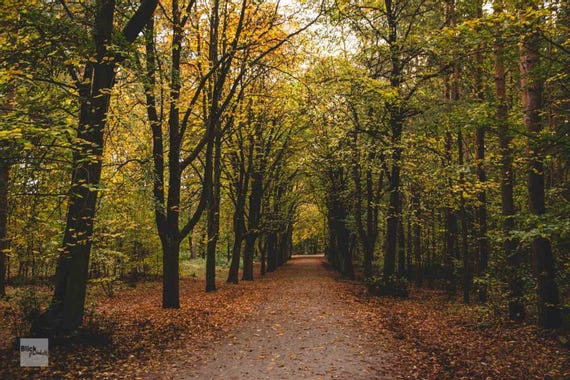
We started running down the dark dirt paths covered with arching tree branches. It was the Gruenewald Forest, in the center of the American sector of Berlin. I couldn’t read the posts, there weren’t a lot of markings, and I realized if I didn’t keep up with Katie - who WAS a fricking gazelle - I would probably get lost trying to find my way back to the cars and look like an idiot in front of everyone. I picked up my pace and tried to keep my breathing in rhythm.
Next adventure that morning - running through my first nude beach. There’s an area in the middle by the lake, the path went straight through it, and I didn’t realize until I was right up on them that the fat men with beer bellies and no shirts weren’t actually wearing anything - no swimsuit, no shorts, just lots of belly that fortunately hung over and covered their bits, as the Brits say. They looked like cheerful gnomes with cigarettes. I’ll admit I missed a pace there and almost stumbled, but managed to keep upright.
When we finally arrived back at the parking lot, the Colonel clapped his hands and said, “GOOD JOB! Katie, I can’t believe she kept up with you! Katie’s the one we send to run the marathon in DC every year, she’s super fast.”
Umm, you don’t say, Sir. Yeah, I made sure I had the paths memorized the next time we ran. Unfortunately, that was the jog where I discovered Gruney pigs and why you want to avoid them - especially the mothers of cute, little furry grunting piglets that you want to pick up and pet. Yowza. Another story for another day.

ANYWAY, on to our Art Gruenewalds.
The first is a rather good niche artist - Austrian artist Guido Gruenwald or Gruenewald (both are spellings of his last name). Gruenwald was the creator of the original Chessie the Railroad KittenCat that turned into an advertising bonanza for the Chesapeake and Ohio Railroad Company in the 1930's. Chessie was first used in a 1933 issue of Fortune Magazine with the slogan "Sleep Like a Kitten and Wake Up Fresh as a Daisy." Chessie, the cat's name, is a derivation of the Chesapeake and Ohio Railroad name.

The promotion proved widely popular and, in addition to national print advertising, grew to include calendars, clothing, and even two children's books about the character. Chessie's mate was Peake, who was introduced in the June 1937 issue of Life magazine and was the father of her two kittens, "Nip" and "Tuck". During World War II, the Chessie character was used to promote War bonds and support for the war effort, depicted as working on the home front to support Peake, who was off to war. The Chessie image continued to appear in advertising until 1971 when passenger train travel was consolidated under Amtrak.


The third Gruenewald, second artist if you’re keeping count, is Matthias Gruenewald. I’m only going to give you one of his paintings today. It’s a doozy and will take a while to examine. It’s the Isenheim Altarpiece (1512-16)
One of the greatest Renaissance paintings of the 16th-century, this complex polyptych altarpiece was created about the same time that Raphael was decorating the Vatican in Rome. It was painted five years before Luther nailed his Protestant theses to the door of Wittenberg Cathedral in 1517, yet it perfectly captures the torment of the early 16th century.
The Commission
The set of panel paintings known as The Isenheim Altarpiece was commissioned by the preceptor Guido Guersi for the main altar of the Antonite Monastery near Colmar. The monastery specialized in the care of plague sufferers as well as the treatment of skin diseases like ergotism (St Anthony's fire) - an intensely painful burning sensation in the arms and legs, caused by eating cereals contaminated by ergot. This accounts for the presence in the painting of both St Sebastian (patron saint of plague victims) and St Anthony Abbot (the patron saint of the hospital's order), as well as the ravaged body of the crucified Christ. The latter image, deliberately pitted with plague-type sores, was designed to provide solace to hospital patients by showing that Jesus understood and shared their painful afflictions.
Composition
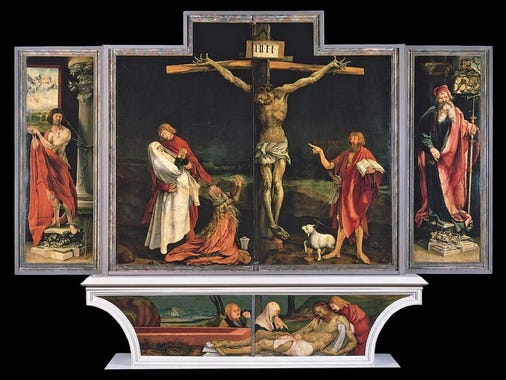
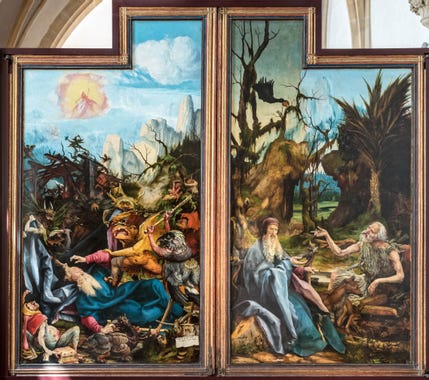
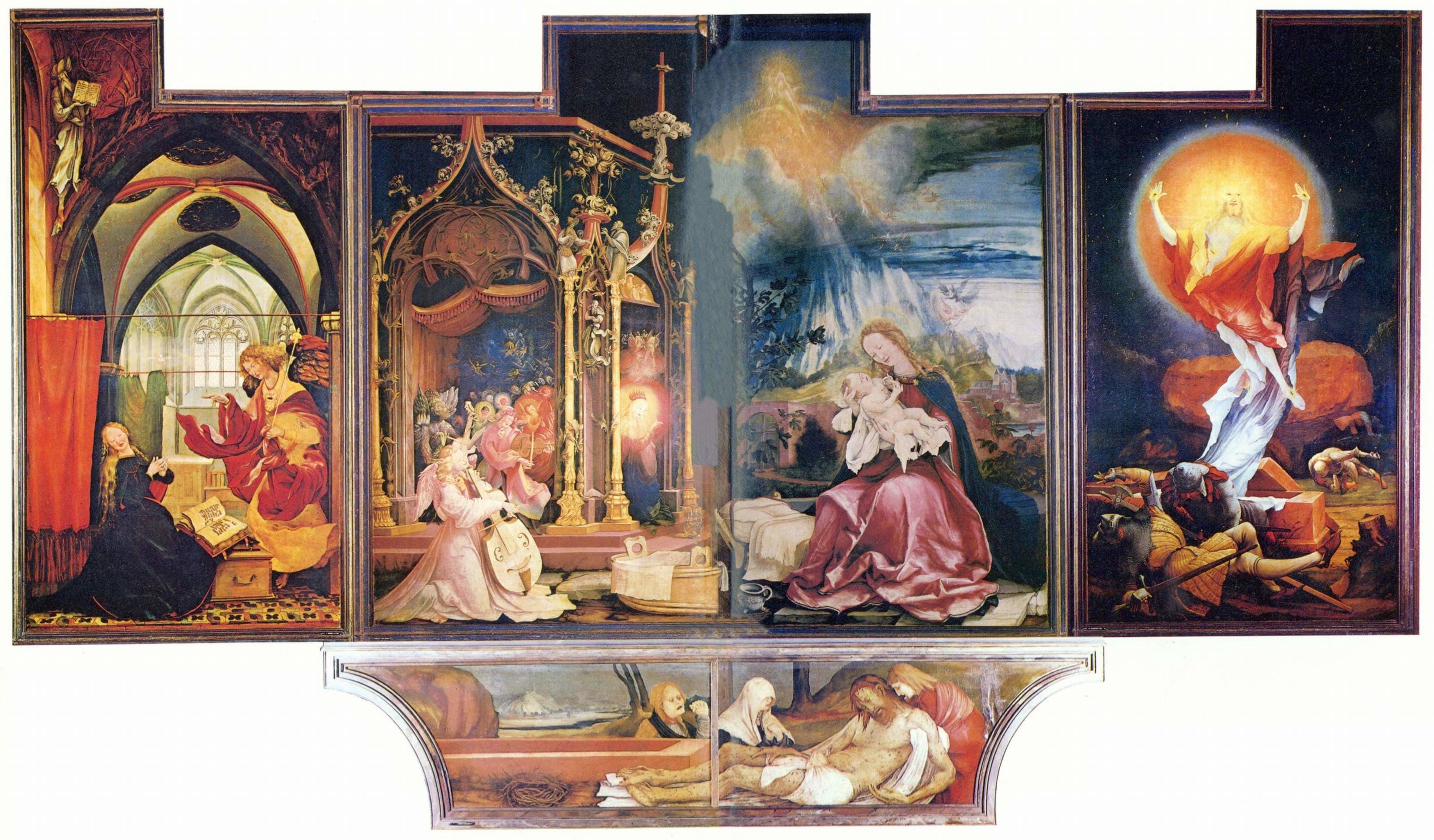
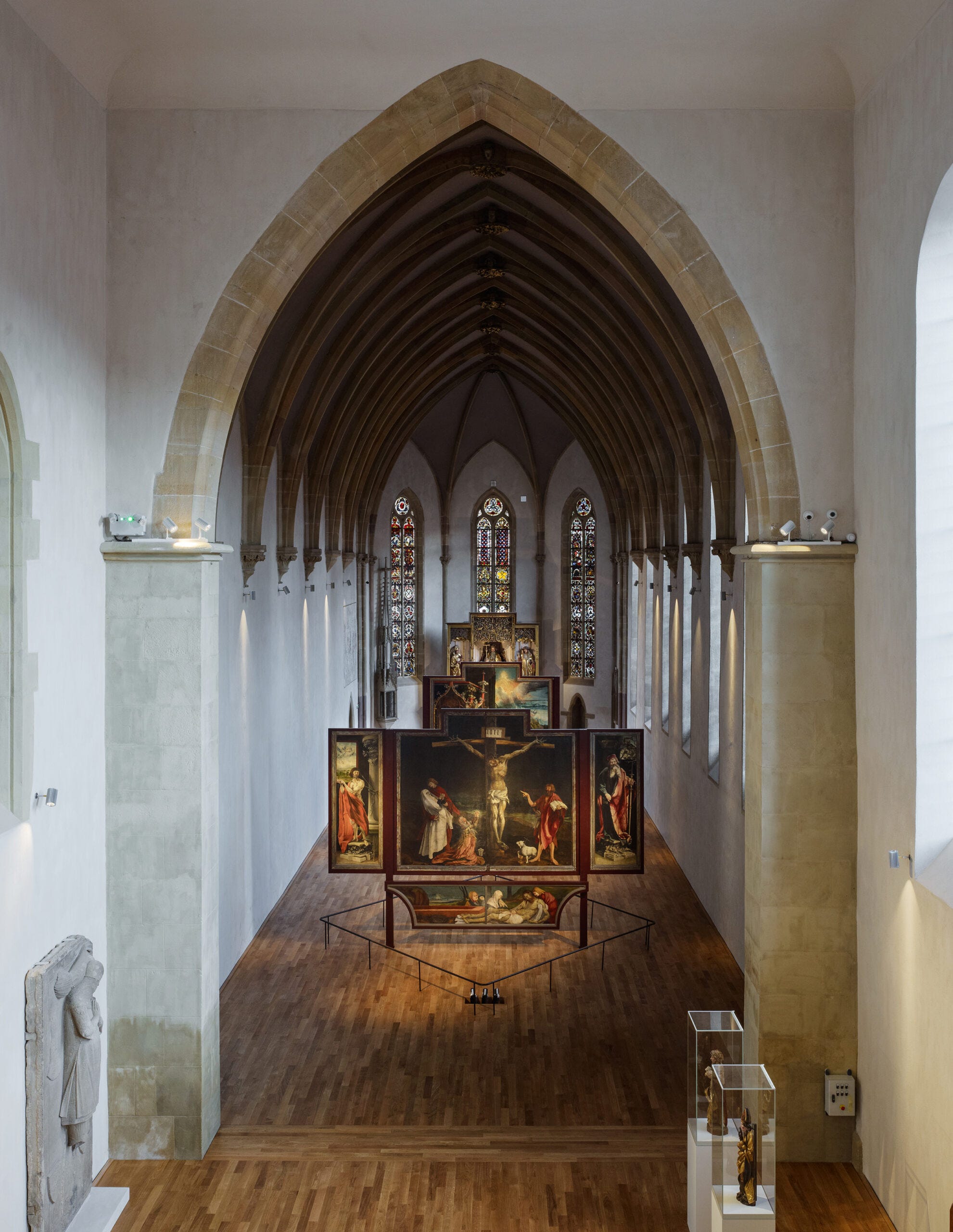
The Isenheim Altarpiece has a fairly complex construction. It is an old sculpted altar, made by Niklaus Hagenauer (1445-1538) and consisting of three carved wood statues of saints, to which six wings (painted by Grunewald) have been attached - three on each side. Four of these wings are hinged and painted on both sides; the other two are static and painted on one side only. All this allows you to change the displayed image according to the day. If you close all the hinged wings, you see a Crucifixion, flanked by Saints Anthony Abbott and Sebastian at the edges; if you open up one pair of wings you see an Annunciation, a Nativity, and a Resurrection; open up another pair and you get Hagenauer's polychrome sculptures of St Anthony, St Jerome and St Augustine, a picture of St Anthony with St Paul the Hermit, and one of St Anthony Being Assaulted by Demons. While the Crucifixion is sombre though livid, the other panels are marked by Grunewald's vivid Renaissance color palette, as well as his extraordinary devil-imagery.
The center opens to show the Annunciation, Nativity and Resurrection, the opening runs between Chris’s right arm - left in the painting - and the wood of the cross, displaying these beautiful panels.
The Isenheim Altarpiece Crucifixion
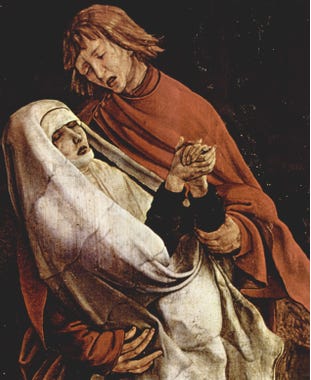
In this monumental work of Biblical art, Grunewald's dark and harrowing portrayal of the Crucifixion shows a horribly wounded, twisted Christ, nailed to the cross. As one critic describes it: it is the most beautiful painting of ugliness in the history of art. Christ's flesh bristles with jagged splinters, as well as the developing sepsis and necrosis. Paradoxically, his nail-pierced hands seem to acquire movement through rigor mortis. Jesus is flanked, on the left, by a kneeling Mary Magdalene and a grieving Virgin Mary being comforted by St John the Evangelist, and on the right, by John the Baptist. At the feet of John the Baptist is a lamb bearing a cross, whose blood flows into a goblet, symbolizing the union between the Old and New Testament as well as the redemption of mankind. Below the Crucifixion panel, a predella represents The Lamentation.
The Isenheim Altarpiece Today
Now displayed at the Unterlinden Museum in Colmar, in France outside of Paris, the altarpiece has been dis-assembled so that all the panels can be viewed independently. Some wood carving is missing from the top and bottom of the work, due to vandalism which occurred during the French Revolution, when the entire painting was nearly destroyed.
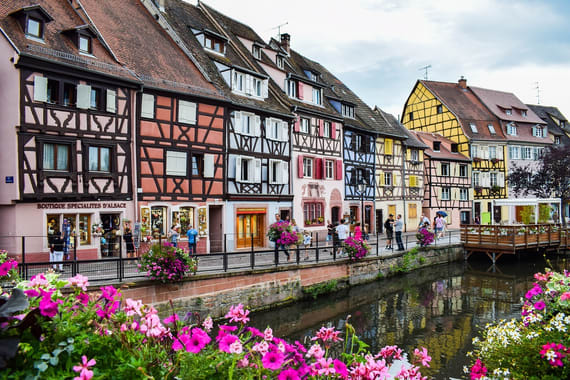
If you need another reason to visit Colmar, France - I mean, if it isn’t enough for you that it’s one of the most beautiful places in the world and probably inspired the setting of the cartoon Beauty and the Beast ( I’m guessing here, it looks just like the Disney movie setting) - here you go. Head to the museum and see in person one of the most beautiful, moving pieces of art in the world. And have a glass of Alsatian wine on the river for me. Please!
Grunewald is the best. The best running paths of my life. When we were in Berlin last summer made the kids rent electric scooters to show it to them from the cut-through roads. I remember the pot bellied old men on the nudist part of the lake playing chess. And the happy biergarten off one of the paths. Another image that really stayed with me was of elderly couples in cardigans with canes walking along ramrod straight. How I'd like to be at 80. Thanks for sharing, G