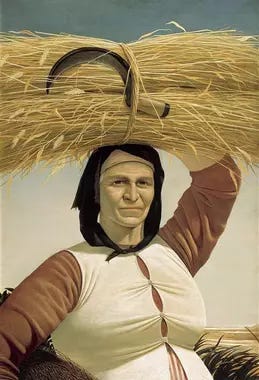
The Countdown to Hectic Holidays begins
Fortunately, I have weird art to keep me on an even keel.

No matter how hard I try to avoid getting ramped up around Christmas, I fail. When those first little bags from my neighbors start showing up on my side porch, I have a little moment of panic. (Well, after I eat the offerings, so technically it could just be a sugar rush.) What am I going to leave at their house? Should I try something homemade, like the two especially talented cooks across the way, or should I go expensive gourmet from Midtown Provisions with cheese straws and a ribbon?
Normally, I go one step further and try to be creative. Taxing, but fun, so it’s probably healthier for me. Anything fun is healthy. Except white wine.
One year I gave a Covid Survival kit - an envelope of nice bath salts, scented soap, six teabags flavored Christmas in Paris, and a small individual sized bottle of schnapps. I think the card said something like COVID Survival Kit instructions - crawl in the bathtub, pretend you're in Paris and hope next year gets better. HAH!. Very cheery. Well, the schnapps would help with that.
My first schnapps was in Germany, circa 2000, with our fun neighbors. Rather than go to our local place at the top of the hill, we decided to venture down a few villages. We didn’t know the regulars there, so got a few stares and nods as we sat down, but overall a welcoming atmosphere with golden rings of light over varying sizes of round wooden tables and a cozy bar in the front of the room. Outside, it was pitch black with stars and bitterly cold. I didn’t have a camera phone back in the dark ages of 2000, but this gives you an idea. Too many little tables in this one though.
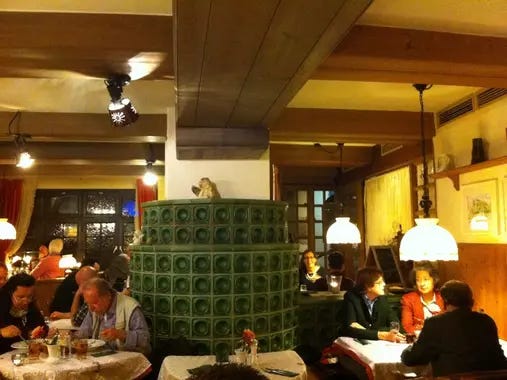
In the corner by the kachelofen sat a table of older men, of an age that they lived through WWII, eating dinner and drinking bier. After finishing their meal, they signaled to the kellner (waiter) and he brought over a tray of cute tiny bottles in brown paper bags. They all wrenched the tops off the bottles, then threw back their heads and swallowed.
Our friend, who spoke better German than the rest of us, nodded at the kellner and said Vier, bitte, and pointed at the other table, then to us. The waiter brought them over and we all acted like this was something we did every meal - took the top off and chugged. WOWEE, that stuff hits you like a hammer. We managed not to spit it out, because the taste was completely unexpected - sort of a cough syrup vibe.
My eyes watered a bit as I made my way to the bathroom - die toiletten - a cold walk outside to a white door makes Ramen in back corner of the courtyard. No discernible heating source. Very old school gasthaus. That frosty air could knock the Underberg right out of you PDQ. And the DREAMS that night. Man, talk about weird. Underberg is powerful stuff.
Expect your first sip of Underberg to be hugely herbal, slightly spiced, and lightly licorice-y, with underlying notes of gentian, clove, and anise. 88 proof. The brand touts that Underberg promotes digestion by stimulating gastric juices and supporting the breakdown of nutrition in the stomach. "Essentially, it's a quick little drink to put an exclamation point on your evening," You don’t say.

Here’s the official website for Underberg, which is a bit steampunk psychedelic - sort of like a German Alice in Wonderland. Hmmm.
(Did you know your stomach acid becomes weaker as you age? You can take Betaine HCL pills to help but I’m thinking Underberg would be much more fun. If it’s good enough for Germans, it’s definitely good enough for me. Ich liebe Deutschland. Prost!)
ANYWAY, on to the art.
Here’s one I’ll bet you’ve never heard of - Pyke Koch, 1901-1991. He lived through WWII as well, which seems to have been pretty tough on artists, especially those who were a bit more avant-garde.
"Pieter Frans Christiaan Koch, better known as Pyke Koch (July 15, 1901 – October 27, 1991), was a Dutch artist who painted in a magic realist manner. He was self-taught as an artist and throughout his life remained committed to sharp-focus Magic Realism, a style of painting in which the scenes depicted seem realistic yet uncanny or unlikely.w
He defined in the following terms to demonstrate his distance from Surrealism: ‘Magic Realism confronts us with situations that are possible, even commonplace but which contain an element of improbability…Magic Realism exists by the grace of ambiguity, which is the source of fascination on an entirely different level to that of beauty (or morality)’.


Above are The Nocturne - which is a pissoir painted with symbolic religious touches - and The Shooting Gallery, two of his most famous works.
His paintings show many details. Some art historians have suggested that these details may contain hidden messages and references to his personal life. The work does contain many references to earlier periods in the history of art. He was very much inspired by painters of the Italian quattrocento, most notably the work of Piero della Francesca.
During the 1930s his work became very popular. His house in Utrecht (Oude Gracht 341) became a regular meeting place for many Dutch writers, painters and designers.


Koch also had friendships outside of his artistic circle. One of these friends in particular would leave a permanent mark on his life. Ernst Voorhoeve was the founder of Verdinaso, a political movement that sympathised with Benito Mussolini's fascist movement. During the years he spent in Italy, where Heddy and Pyke had a bed & breakfast in Fiesole for a while, Koch started to admire Mussolini. Koch became a member of Verdinaso but renounced it when it merged with the Dutch Nazi party NSB. By that time, some of his paintings had appeared on the covers of magazines associated with fascism. This would prove to be a stain on his reputation that would stay with him for the rest of his life.
In those years Koch painted many masterpieces that were widely admired in exhibitions. He was also active as a designer for graphic work. He designed postage stamps and the Utrecht street lights.


He continued to work during the war. Like many of his colleagues he painted mostly still lifes because those were least likely to offend the Germans.
After the war his work became less popular. Abstract expressionism and other more conceptual forms of art became the norm. All forms of realism were considered old fashioned. Still he had a fan base that continued to buy his work.


Koch was a perfectionist in the extreme. He worked slowly and destroyed many of his works because he was not satisfied with the result. His oeuvre is therefore quite small. Still it has been incorporated in all major collections in the Netherlands.
Early in the 1980s Koch was diagnosed with Alzheimer's disease. As his physical and mental abilities declined, he gradually withdrew from public life. He died in Wassenaar on October 27, 1991. He was a slow and meticulous worker. By 1982, after 55 years of painting, he had completed only about 80 pictures.
So, another great artist to teach us another great lesson. Paint, paint, PAINT and try not to get too hung up on the details. ( I should know, I worked on a Randersacker, Germany painting of a building for a YEAR and I still don’t like it. And now it’s hideously overworked. Should have quit earlier and moved on to something else. On the upside, I didn’t destroy it.)
Herr Koch, what you considered inadequate would have probably been genius work from a lesser artist. I get it - you had extreme quality control standards. But I'm still curious about those other paintings that didn't make the grade for you.