
Quilting and Dame Laura Knight
Jumping into something new rewires the brain

Well, I DID IT! Our church has a quilting team that meets every Monday afternoon, making different size quilts for the local hospital - neonatal, bereavement, children in ICU or rehab, and so forth. The wonderful woman who leads the Screwtape Letters study mentioned it at our last session and my ears perked up. QUILTING! One of my interests from my brief 10 month sabbatical - also called unemployed - after I moved to an Army post with my husband.
That was back in 2009. I bought a sewing machine - I’d never touched one in my life - read the instruction booklet, managed to thread the needle and bobbin and get the pedal in the right position on the floor. Then I talked three other bored Army wives into signing up for a quilting class at a local fabric business. Two Australian wives, a Canadian wife and me as the token American. Fun!
We had a good time, I still have the fractions of the quilt I started. I never finished it, but I DID make a few duvet covers out of old sheets, with strips to tie to close at the bottom - I never quite figured out that button hole feature.
My sewing machine is long gone, given to a neighbor who lost hers in a house fire - and I wasn’t really using it, I’d gone back to work and had enough pressure in the office that I just vegged on the weekends.
Last Monday, I drove to the quilting bee - that’s what I’m going to call it, very Laura Ingalls Wilder or Little House on the Prairie if you’re one of the sad people who wants to ghost LIW for her Indian fiction. The QB meets in an empty residential home near the hospital, furnished upstairs as a regular house with one room set aside for hand quilting. After climbing down a deep, uneven set of stairs to the basement, I saw a well lit cinderblock room with six sewing machine tables, an ironing board, cutting area and a closet full of bolts of quilt cloth. Nirvana!
Wanda put me at a sewing machine, handed me a jelly roll of fabric - apparently you can buy them for $5 at the Dollar Tree, I learn something useful every day - and kindly showed me how to get started as a remedial stitcher. Much appreciated. I would have hated to embarrass myself in front of Donna, June and Fran, the other quilters who had the pedal to the metal already, churning out sewn material while talking and laughing about husbands, recent cruise vacations and church matters. Instant community.
I stitched from 1 until 5 pm, and it flew by like half an hour. I’d forgotten what it felt like to be in the creative zone, concentrating with just the eye and the arm, without all that latent anxiety that spins like a dervish in my brain most days. I got a little sloppy towards the end, so next week I’ll have to rip out a seam or two and re-stitch - that quarter inch line was wavering a bit once my hands got tired. I can’t wait to see how the quilting machine in the back room works when I get to the batting stage.
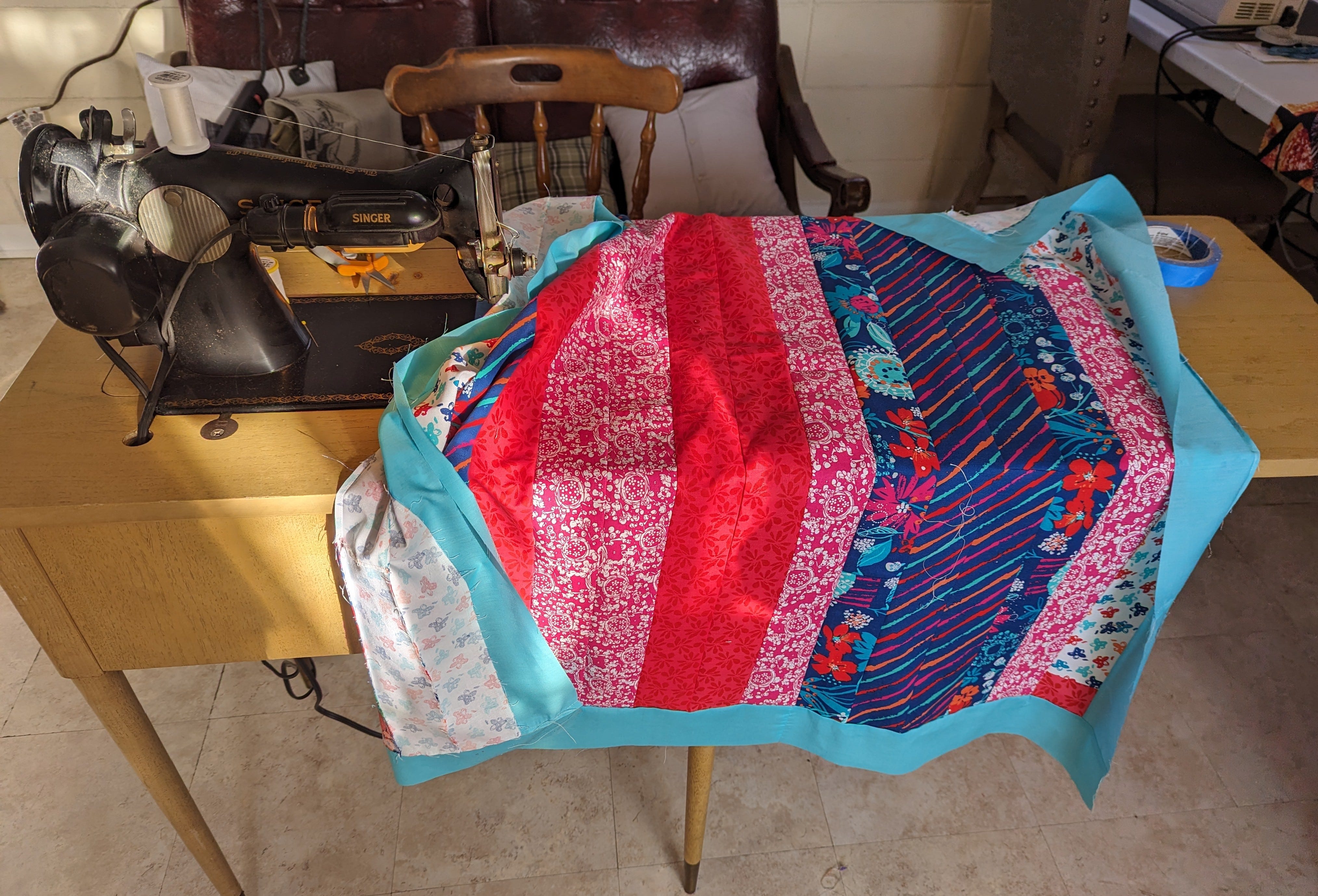
SO, it looks like a visit to the sewing machine section of the craft shop is in my near future. Although Wanda assures me that I can find a serviceable one at one of the local charity outlets. Check out my quilt on this little baby she bought for $25 at the Rescue Mission - for table and machine. This is the one she used, I had a modern one, thank goodness.
ANYWAY, on to our artist. Biography from Bonhams.com.
Dame Laura Knight (née Johnson) was born in Derbyshire in 1877, the youngest of three sisters. Her father, whom she never met, walked out soon after her birth, leaving her mother to fend for the family. Her resourceful attitude was instilled in her daughters, whom she raised to be independent and to provide for themselves by promoting their educations and nurturing their abilities.

Knight spent some time with relatives in Northern France before returning to England aged 13 to enrol at the Nottingham School of Art, where her mother was teaching part-time. During this early stage of her studies Knight already showed promise and won several awards, including a Prince of Wales scholarship. These prizes were welcomed as she was struggling financially following the untimely deaths of her mother and sister as well as of both grandmothers.


At the School she met a talented fellow art student named Harold Knight, whom she married in 1903. In 1907 the Knights moved to the south coast of Cornwall and joined an art colony known as the Newlyn School, which gathered artists who painted en plein air, in the Impressionist style. Knight spent most of her time painting on the beaches of the area, creating some of her most identifiable seaside and landscape works.


In 1913 Knight finished what would become one of her most recognised masterpieces: Self Portrait with Nude, (please click link for painting, I can’t reproduce it here without permisison) which depicted Knight herself in the act of painting her friend and artist Ella Naper in the nude. It is a complex composition and Naper in fact appears twice: posing and painted in the canvas. It’s a stunning and disconcerting work that combines a number of achievements that were revolutionary at the time: it is a self-portrait that makes a strong woman-artist statement while also being a representation a female artist painting a female nude, dispensing with the male gaze associated with centuries of painting.
The Knights moved to London in 1919, and soon after she was invited backstage during the third season of Sergei Diaghilev’s Ballet Russes. She became utterly fascinated and started drawing and painting backstage scenes of the company, which featured some of the most famous dancers of the time, including Lydia Lopokova and Anna Pavlova.


In the early 1920s Knight attended the Bertram Mills Circus at London’s Olympia and was again beguiled by that carnivalesque world. She began painting and drawing the circus performers and even joined the Bertram Mills and Great Carmo circuses on a joint British tour between 1929 and 1930, during which she mastered the art of painting lively, complex scenes at great speed.


Knight was the only woman artist to receive war commissions across the two World Wars, with these works being exhibited at the National Gallery. In 1916, during the First World War, she received a commission for the Canadian Government War Records to convey the theme of physical training in a camp. In 1939, at the start of the Second World War, she was asked to produce a recruitment poster for the Women’s Land Army.


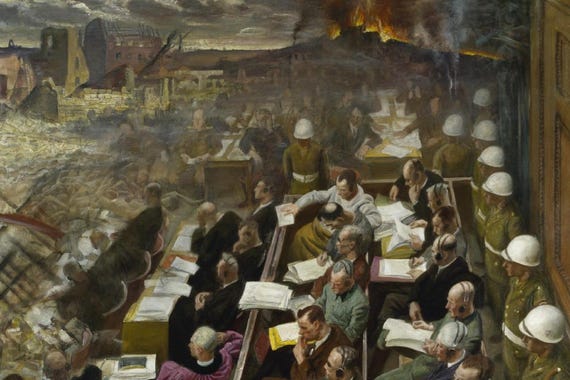
Another important milestone came in 1946, when she became the only British artist to cover the Nuremberg Trials. She pitched herself to the War Artists' Advisory Committee. The resulting work, the large-scale painting The Nuremberg Trial was received with reservations at the time but has eventually been recognised as one of her masterpieces.
With her prolific production, tireless work ethic and passion, and resounding successes during her lifetime, Knight blazed a trail for the women artists of her time and for those to come, embodying the increasing inclusivity of art institutions and the growing interests of the public in female perspectives and art made by women.
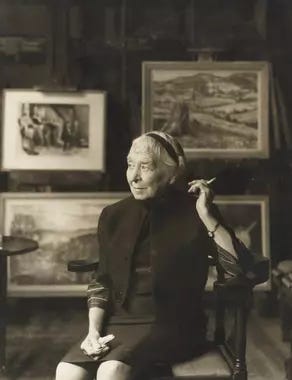
I’ll bet this lady has some stories to tell over a cup of tea and a cigarette. Dame Knight is a great example of letting curiosity and love of art permeate your entire lifespan. I can but aspire.