
Kandinsky, Muenter and Me
I am their humble acolyte. (But you knew that.)

Today we’re hitting my first landscape, painted back in 2014 or 2015. I wanted to paint a German street scene, and I had a photo of the square around the old Rathaus in Weiden, Germany. Weiden and Amberg were the two closest towns of any size near our little village of Freihung.
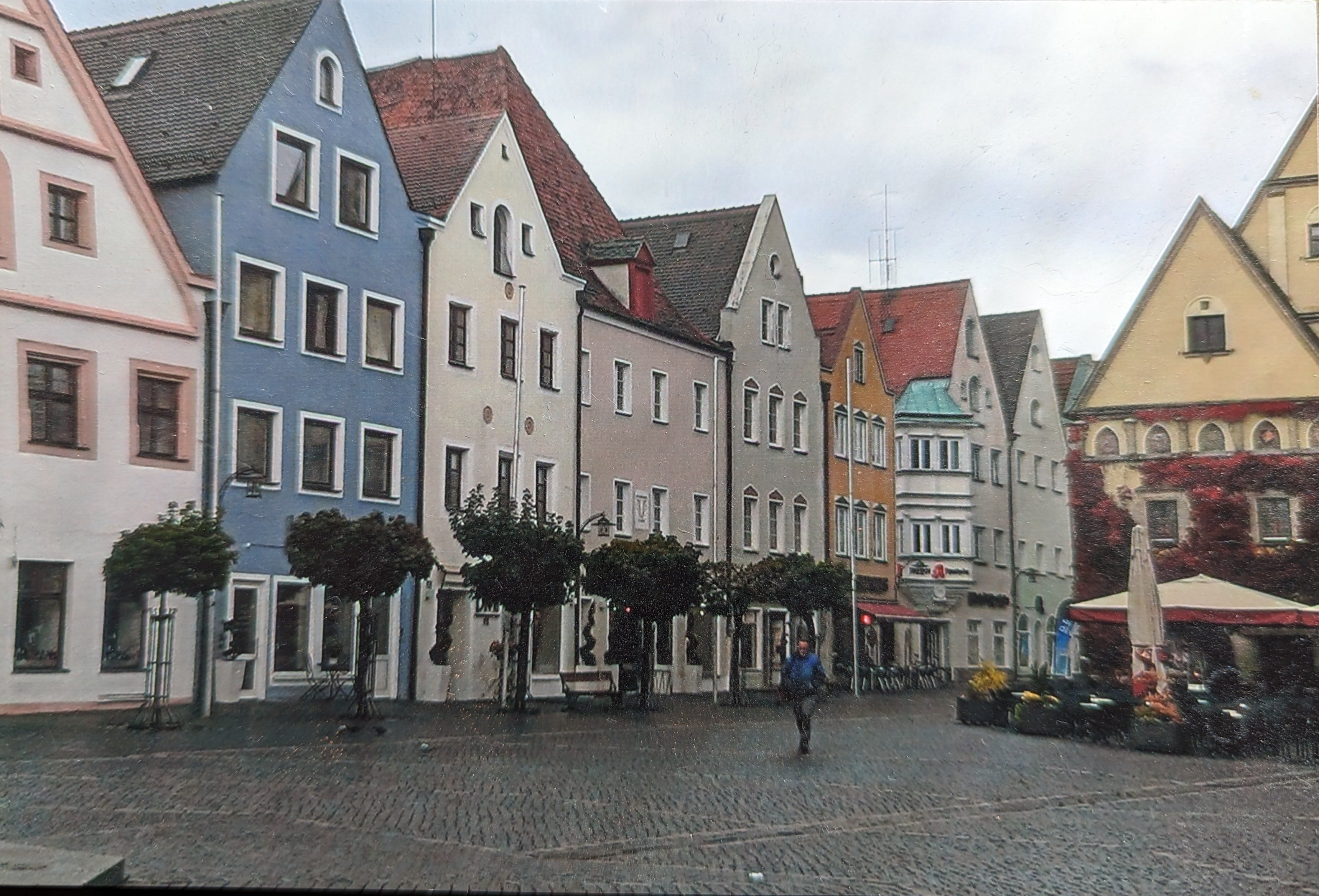
Weiden was my favorite of the two. I knew where to park, the pedestrian zone was easy to navigate, and I had my favorite coffee shop, tea house, kaufhaus (department store), millinery shop with great felt hats and a restaurant (BräuWirt) within a three block radius.
That’s the rathaus on the right, the mustard colored building with the pretty climbing vine that turns bright red in the Autumn. Note the big square umbrellas in front where you can walk out from the cafe with your cup of tea or coffee - or a bowl of ice cream - and sit in the sun like a cat seeking a warm spot. Lots of cool days in Germany are made bearable by sweet sparkling sunshine.
In the good old days, German and American attorneys would come in from the other military posts and we’d gather here in the early evening in Summer, when the sun stayed in the sky until after 8 pm - having wine and talking shop. Then having more wine and talking about more important things - boyfriends, girlfriends, kids, travel on the weekends, and lots of jokes and funny stories.
If you walked back from where I stood to take the photo, you’d quickly stumble into my favorite cafe, The Brunner, a little fresh market on the first floor and a Viennese style coffee house on the second. If alone, I’d take a book and order pastries, weisswurst and a kannchen of coffee - I’d just keep pouring cup after cup as I read and looked out the window onto the square or side alley.
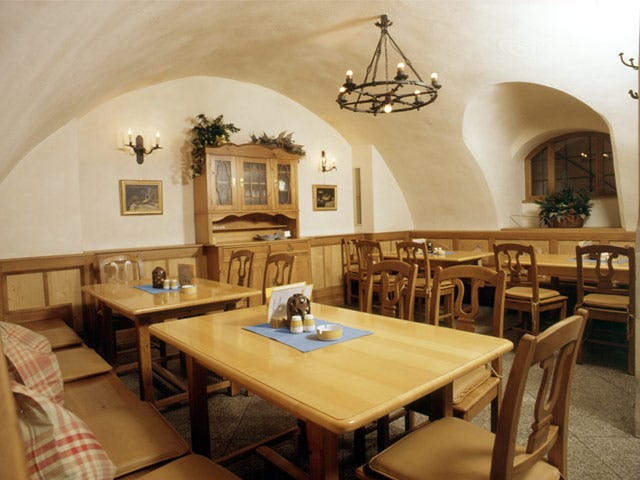
My favorite restaurant is better known for their brewery. BräuWirt is famous for Zoiglbier, but I normally had a glass of dry white wine with my Käsespätzle. Whenever we travel back to Germany, we swing by our old stomping ground to meet the attorneys and legal staff left - some have retired or moved on - for a bier and chin wag in the cellar room. Good times!
ANYWAY - on to my little painting. I decided to take a stab at landscapes before I ever had a landscape class or knew the rules of painting one. Fortunate, indeed, that I love German expressionism, because this one is quite the homage to my favorites, Wassily Kandinsky and Gabriele Muenter.
Here’s the progression.


I took a bit of license with the colors - just a bit ;) - and really had fun with the sky and not as much fun with the cobblestones. Tougher than I expected, so I did my best, then kept moving. Added the window boxes. and decided it was easier to silhouette the man than try to include my first person inside my first landscape. Here’s where I ended up.
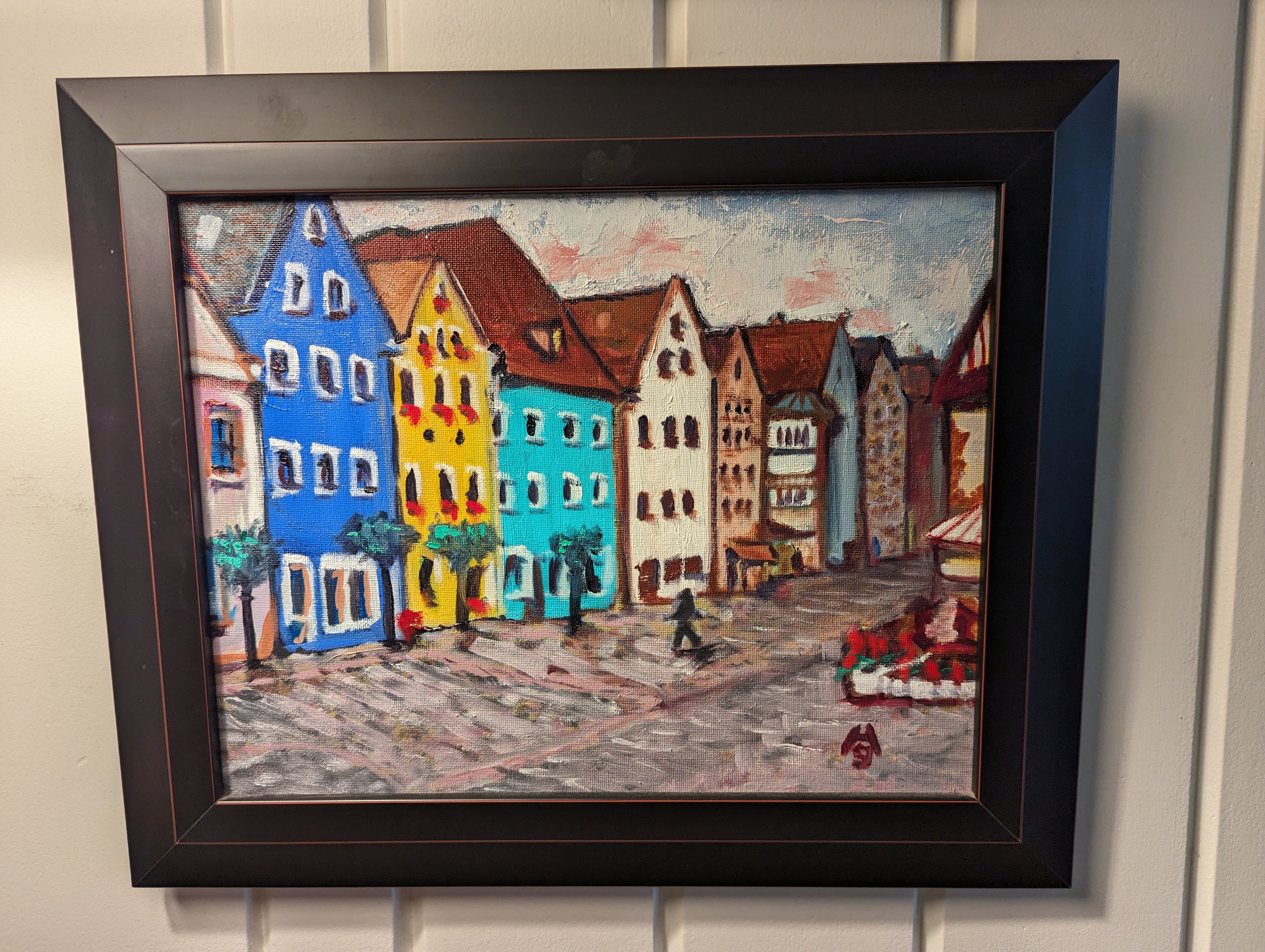
I sort of love it. Great memories, and it’s happy, cheerful and even the man looks a bit jaunty. Even better, when I first put it up on Facebook, an American officer who’d also been stationed here knew exactly what I’d painted - Weiden Rathaus and square. So, in addition to being my first landscape, it became my first recognizable location. FUN!
Every trip back to Germany, I try to include at least one week of an art pilgrimage. One year, we went to Murnau am Staffelsee, where Kandinsky and Muenter lived in this adorable little cottage. You can tour it now - the house is a work of art. Kandinsky painted the stairs, and you can see the rooms in some of paintings.
Gabriele Münter purchased the house on the Kottmüllerallee in Murnau on August 21, 1909. From then until 1914, Gabriele Münter (1877-1962) and Wassily Kandinsky (1866-1944) frequently stayed in the house popularly known as the Russenhaus (“House of the Russian”). They furnished it together, laid out the garden, and decorated their furniture with their own painted designs.


The countryside around Murnau, but especially the house itself, the garden, and the immediate surroundings, were an important source of inspiration for Münter and Kandinsky. They often painted the window views of the church, the castle, or the mountains. It was through his interest in the landscape that Kandinsky’s painting developed toward abstraction.
Some of Kandinsky’s paintings of Murnau.


The Münter House also played a formative role in the history of the Blue Rider. It became an important meeting place of the avant-garde. Franz Marc, who lived in nearby Sindelsdorf, Alexej von Jawlensky, Marianne von Werefkin, August Macke, and Arnold Schönberg were frequent visitors, as well as collectors and gallerists. Working meetings preparatory to the publication of The Blue Rider Almanach took place here in October 1911. Besides Münter and Kandinsky, Franz and Maria Marc and August and Elisabeth Macke were involved.
Gabriele Muenter’s paintings of the Murnau area.


When the First World War broke out in 1914, Münter and Kandinsky first fled to Switzerland, since Kandinsky, being Russian, was now considered one of the enemy. He returned to Moscow in November 1914, where he was to remain until 1921. Gabriele Münter lived in Sweden from summer 1915 until December 1917, finally settling in Copenhagen.
At the start of 1920, Münter returned to Germany. From 1931 until her death in 1962, the painter lived in the house in Murnau again, from 1936 on together with her later partner, the art historian Johannes Eichner (1886-1958). In the basement of the house, she safeguarded an inestimable treasury of paintings, mainly by Wassily Kandinsky, but also works of her own and by other major Blue Rider proponents and those of the broader circle, thus rescuing them in the era of National Socialism. On the occasion of her 80th birthday, Gabriele Münter donated important parts of this unique collection to the Städtische Galerie im Lenbachhaus in Munich.
HAHAHA! Too funny. They very tactfully left out that the reason she had so many works by Kandinsky - she threatened to SUE the bastard after he left her high and dry, marrying a 17 year old after being engaged to Muenter for years. (Strangely, Kandinsky had been married for ten years when he met Gabriele. She knew he was married, but accepted his proposal in 1903. They were ‘engaged’ for over a decade.) Here’s a better account:
In 1911 Kandinsky officially divorced Anna. When the First World War broke out in 1914, Muenter and Kandinsky fled to Switzerland. However, the War provided a natural break for the two artists who lived apart for the majority of the conflict's duration. By September 1916, Kandinsky, by now in Russia, began a relationship with seventeen-year-old Nina Andrejewska. Nina would become his second wife in 1917, though Münter only learned of their marriage in 1920. Münter and Kandinsky were never to meet again, though Münter repeatedly attempted to contact him in the 1920s to retrieve works which were still in Kandinsky's custody. Scholar Annegret Hoberg describes Münter's pursuit as a symbolic quest for "moral amends" rather than "material compensation." Indeed, as part of the restoration of her property, Münter forced Kandinsky to admit that the two existed in a "marriage of conscience" if not in legal status, and, in 1925, she began a text entitled Confession and Accusation, which excoriated Kandinsky for ill-treatment
She met him as a naive, unmarried young woman in her early twenties and he was the caddish, if sexy, Russian artist. She was definitely attracted to the bad boy type. He must have been stunned when she stood up to him and took him to the cleaners, so to speak.
They also lived together in a town called Kallmunz, near Munich. I’ve visited there, as well, it’s a pretty little town with some of the houses built into a stone cliff wall, and a picturesque river through the center.
I wanted to see some other places they painted, so we stayed a night at the Griesbräu, which turned out to be a great idea. Have a few beers or glasses of wine, then stumble upstairs to the bedroom. I’m pretty sure we weren’t the first with this great idea - Griesbräu has been around since 1676. Here’s Kandinsky’s painting next to the view from the window.


Gabriele and Wassily were great art partners for a while, and their art and love story gave me a great road trip. I might need to revisit this place again. Hmmm.
love these. street scenes makes me miss Germany so much . . .