
Eternity and Digory
My walk, Chronicles of Narnia and Frank Cadogen Cowper

“When things go wrong, you’ll find they usually go on getting worse for some time; but when things once start going right they often go on getting better and better.”
― C.S. Lewis, The Magician’s Nephew (Chronicles of Narnia, #1)
Another rough night. (Although, MANY THANKS to fellow substacker Jan Stoneburner, writer of That’s Good To Know , for her recommendation of the book Whole Brain Living by neuroscientist Dr. Jill Bolte Taylor. Ordered, it arrives on Monday.)
I woke up to let Newt, our littlest cat, out on the screen porch to the litter boxes at 1:00 a.m. Yes, we have a cat door. Don’t ask. We love her little idiosyncracies, like fearing the dark and wanting someone to cuddle her at 4 a.m. A long night.
As I laid in bed at 0430 trying my hardest to go back to sleep, I started to have the same ruminating thoughts as always. I’m only supposed to use my Vedic meditation mantra during my twice a day twenty minutes, but I’ll sometimes make up a nonsensical word and use it the same way during these dark, sleepless hours. I tried it, but the thoughts kept creeping in.
Out of the blue - or so it seems - I started to repeat John 3:16 over and over. For God so loved the world, he gave his only begotten son, that whosoever believeth in him should not perish, but have everlasting life. For GOD so LOVED the world, he gave his ONLY son, so that whoever believes in him shall not die, but live in everlasting light.
And instead of seeing Christ on the cross, miserable, hurting, in terrible agony, I saw his eyes and imagined what he’d look like if he was looking at me with love. And humor. Like looking at a silly, funny, adorable child. And my eyes filled up and I slept.
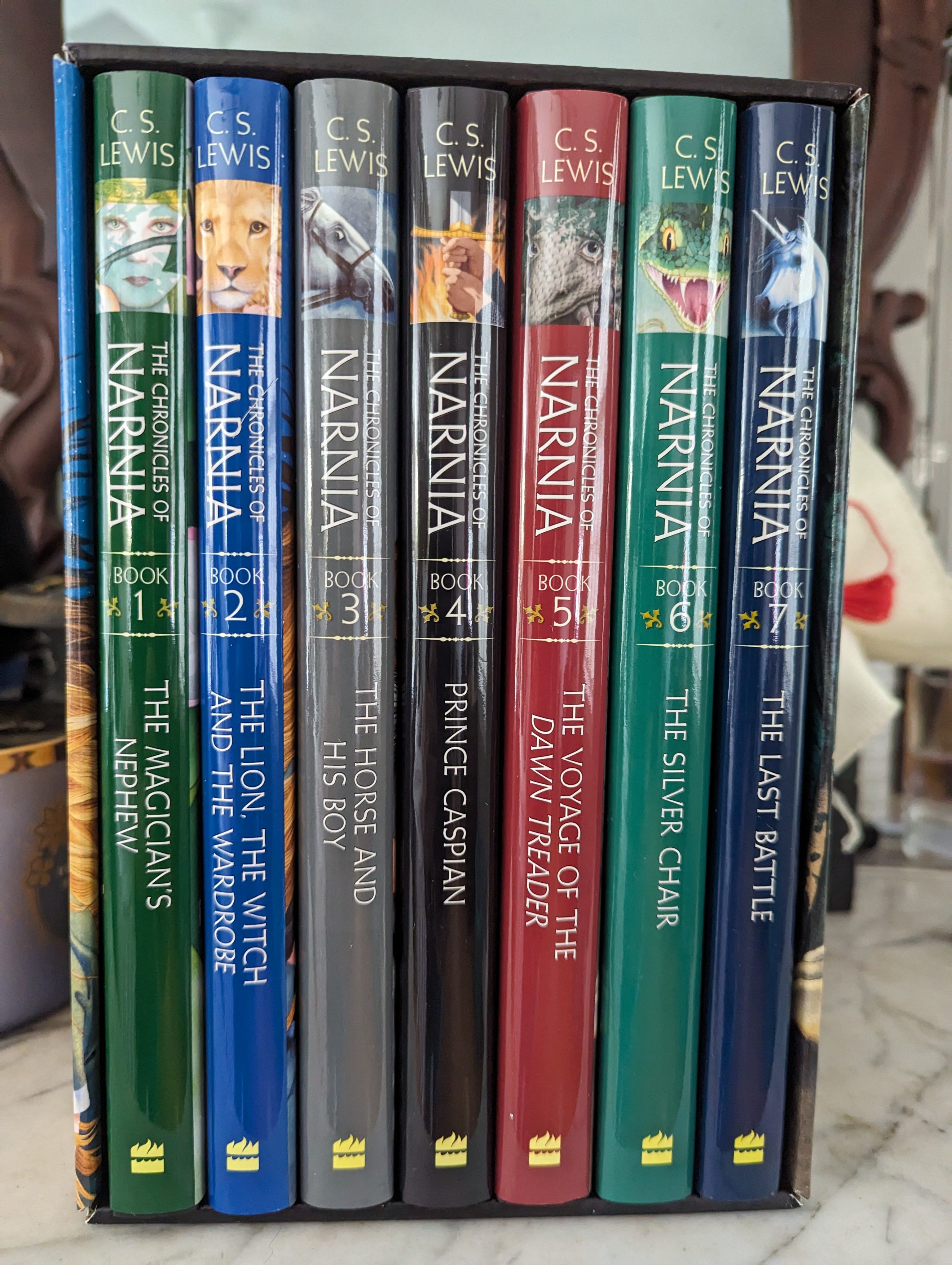
When I woke up, I still had the peaceful feeling with me. I didn’t turn on my Kindle Fire, but started reading the first book of the Chronicles of Narnia, The Magician’s Nephew. My husband gave me the entire set in hardback for Christmas. I read about Polly and Digory going to the in-between world and jumping into ponds, entering the horrible land of Charn with the evil, beautiful queen, then jumping into another pond and witnessing Aslan creating Narnia - the firmament, the rivers, the flowers, the animals.
C.S. Lewis was a GENIUS at moving the hearts of children, but his books also move the hearts of adults. (Or maybe just those of us who realize that we have to return to our time as a child to really understand and trust the magnitude of the gifts we have. We don’t have to EARN them, we just have to see and accept them.)
I finished the wonderful, moving, heroic yet human story and ran out to give my husband a hug and kiss to thank him again, then put on my winter walking clothes and stepped outside. It’s 39 degrees here, beautiful crisp skies, light blue with white whispers of clouds. The camellias are in full bloom and the path was dry. I started out with Cardio music for the first thirty minutes, then switched to my OIa Gjeilo station. I kept wondering why my second timer hadn’t gone off, SURELY I’d walked the full hour. No, I hadn’t hit the start button the second time.
Well, it’s a gorgeous morning. I’ll listen to one more song for a slow down lap, then hit the shower. And this beautiful music beegan to play. I’d never heard it, but after all the other experiences, I smiled and my eyes filled up. I pulled my phone out to check the title. Eternity, by David Tolk.
I walked another lap and imagined God as Aslan walking beside me, keeping pace, loving me, encouraging me, enjoying me. And it was the best walk I’ve had in a long, long time.
I’ve spent so much time trying to figure everything out - why does God allow illness, evil, strife if he can prevent it, if he can cure it? Is it God? Or the Universe? Source? Or quantum physics? Does he care or just watch coldly, like a scientist in a lab? What happens when I die? If God allows cancer and pain, does he really love us at all?
“Oh, Adam’s sons, how cleverly you defend yourselves against all that might do you good!”
― C.S. Lewis, The Magician’s Nephew
“But please, please - won't you - can't you give me something that will cure Mother?'
Up till then he had been looking at the Lion's great feet and the huge claws on them; now, in his despair, he looked up at its face. What he saw surprised him as much as anything in his whole life. For the tawny face was bent down near his own and (wonder of wonders) great shining tears stood in the Lion's eyes. They were such big, bright tears compared with Digory's own that for a moment he felt as if the Lion must really be sorrier about his Mother than he was himself.
'My son, my son,' said Aslan. 'I know. Grief is great.”
― C.S. Lewis, The Magician’s Nephew
“And all at once (they never knew exactly how it happened) the face seemed to be a sea of tossing gold in which they were floating, and such a sweetness and power rolled over them that they felt they had never really been happy or wise or good, or even alive and awake before. And the memory of that moment stayed with them always, so that as long as they both lived, if ever they were sad or afraid or angry, the thought of all that golden goodness, and the feeling that it was still there, quite close, just around the corner or just behind some door, would come back and make them sure, deep down inside, that all was well.”
― C.S. Lewis, The Magician’s Nephew
So if you’re having a hard time, if you’re depressed, or anxious, or discouraged, try reading Chronicles of Narnia again. Let your child side back out, wonder and wander in amazement at the enormous and beautiful world.
Tomorrow, I start #2, The Lion, The Witch and The Wardrobe, my favorite book of all time.
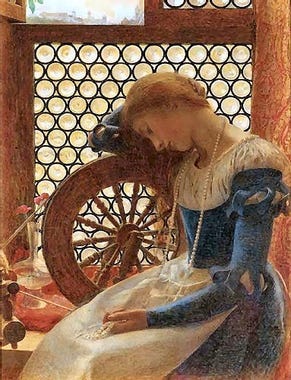
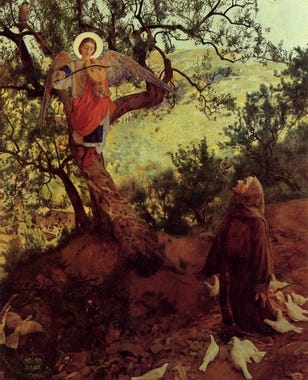
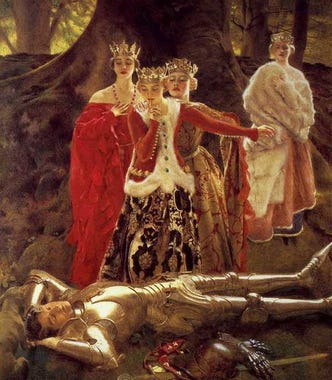
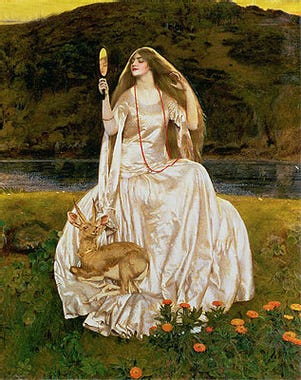
ANYWAY, in keeping with my spiritual morning, I thought I’d share my favorite Madonna painting. Our Lady of the Fruits of the Earth by Frank Cadogen Cowper, 1877-1958. Cowper was born at Wicken in Northamptonshire, where his maternal grandfather was rector. He studied art at the St John's Wood Art School and then spent five years in the Royal Academy Schools (1897 -1902) before entering the Cotswold studio of Edwin Austin Abbey.
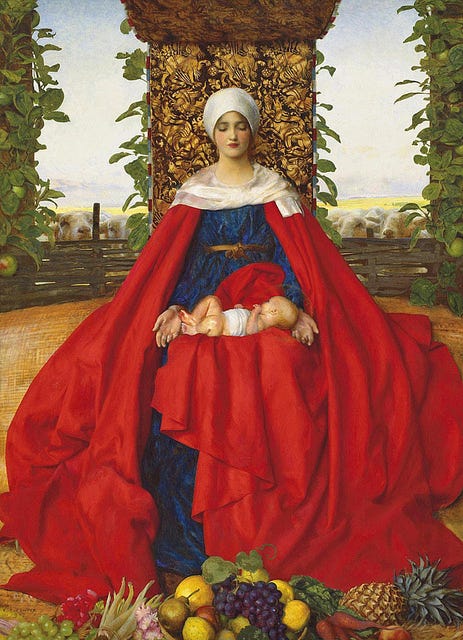
From Christie’s catalog - Our Lady of the Fruits of the Earth had appeared at the RA in 1917, when the artist was forty. It was one of four pictures he submitted that year, the others being portraits. The First World War still had a year to run, and the picture may make oblique reference to the crisis. The themes of motherhood, fecundity and regeneration, not to mention the mood of calm serenity, all seem to hold promise of the renewal that will, hopefully, come with the return of peace.
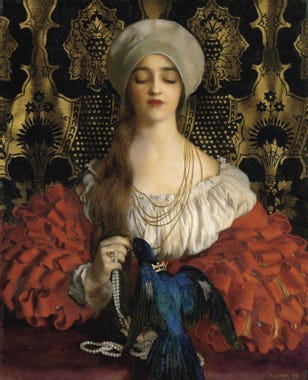
At the same time the picture must have struck an incongruous note among the many RA exhibits referring directly to the war in a more realistic idiom. The following year Cowper was to move even further away from current events in The Blue Bird, his chief RA exhibit of 1918. Sold in these Rooms on 15 June 2011, the picture seems to be frankly escapist, illustrating a fairytale by Madame d'Aulnoy.
The two pictures have significant points in common. The model seems to be the same, and in each case she wears a white coif and sits before a brocaded hanging. This is set immediately behind her in The Blue Bird, precluding any hint of distance, but in Our Lady is pushed back, allowing vistas to open up on either side.
Like so many of Cadogan Cowper's pictures, Our Lady is full of references to art history. Perhaps the most obvious is the canopied hanging, clearly imitating the so-called 'cloths of honour' that so often hang behind the Virgin and Child in Renaissance paintings. Cowper's letters suggest that he was particularly aware of Flemish prototypes for this motif, and he may well have seen the exhibition of Flemish art held at the Guildhall Art Gallery in London in May 1906, which contained relevant works by Jan Van Eyck, Hans Memling, and others. Meanwhile numerous Italian examples were available to him in the National Gallery. In fact there were nearly twenty by 1917. Some of the most notable, such as Bellini's Virgin and Child and Mantegna's Virgin and Child with SS Mary Magdalene and John the Baptist, had been in the collection since they were acquired by Sir Charles Eastlake in 1855.
There are also quotations from the early Pre-Raphaelite paintings that Cowper admired. The sheeps' heads looking over the wattle fence have clearly been 'lifted' from those in Millais's masterpiece The Carpenter's Shop. The foliage that frames the patches of sky seems a deliberate echo of the vine in Rossetti's Girlhood of the Virgin; and the form of the baby, together with the way he is 'presented' rather than being embraced or fondled, recalls the new-born child in Madox Brown's unsettling picture Take your Son, Sir. It is true that none of these works had yet entered the Tate Gallery, where they all hang today, but a dedicated Pre-Raphaelite follower such as Cowper would undoubtedly have seen either the originals or reproductions. After all, Burne Jones's Sidonia von Bork was not in the Tate when he painted the picture that so obviously pays it homage, Vanity.
Our Lady of the Fruits of the Earth was not Cowper's first attempt at this type of composition. A simpler version in watercolour, entitled The Morning of the Nativity (private collection), had been exhibited at the Royal Watercolour Society in 1908. It was included in The Last Romantics (no. 160), and is illustrated in the exhibition catalogue. Other variants, whether paintings or preliminary studies, are either known or recorded.
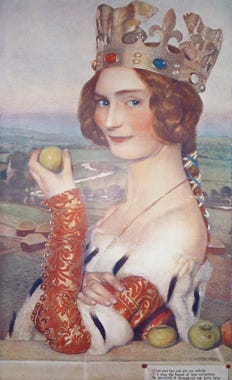
Here are a few more of Cowper’s paintings. The first one, titled A Merciles Beaute, looks EXACTLY like I’d imagined the witch in The Magician’s Nephew. She’s even eating an apple! Although it’s not silver, so maybe we’re safe.
So, a bit of an epiphany day. And if I get another dark night of the soul, I hope I’m strong enough to emulate the Cabby and not the Magician.
“Now then, now then,” came the Cabby’s voice, a good firm, hardy voice. “Keep cool, everyone, that’s what I say. No bones broken, anyone? Good. Well, there’s something to be thankful for straight away, and more than anyone could expect after falling all that way. Now, if we’ve fallen down some diggings – as it might be for a new station on the Underground – someone will come and get us out presently, see! And if we’re dead – which I don’t deny it might be – well, you got to remember that worse things ’appen at sea and a chap’s got to die sometime. And there ain’t nothing to be afraid of if a chap’s led a decent life. And if you ask me, I think the best thing we could do to pass the time would be sing a ’ymn.”
― C.S. Lewis, The Magician’s Nephew
Ah, I see you already know the secret to peace & joy -- tapping into the part of your brain that makes you childlike -- the part that is unlocked by music, art, movement & meditation. I hope you love Dr. Taylor’s explanation. Please, let me know. Thanks for the shout out. --Jan xoxo