
Architecture Art and Avoidance Art
My art choices today are polar opposites

Here I sit, waiting for my husband to come back from the gym so I can take the station wagon to the grocery store. My church needs small candies, canned meat, canned soup, stuffing mixes and canned fruit for the holiday food bank. After all the support they’ve given me this year while I unkinked my stomach and brain, I think I can provide a little quid pro quo here. Easily.
ANYWAY, I spent the time after my morning shower and folding piles of laundry idly going back through some old art I’d saved but never really studied. (Fortunately, this loss of something digital has not bothered me as much today as earlier in the week. The progress continues. Hah!)
First, a painting by Emanuel De Witte. I can admire his art, but I definitely can’t aspire to it unless I want to fail dismally. I don’t care what these Law of Attraction people say, I won’t ever be a rock star or opera singer or painter of beautiful architecture, no matter how hard I concentrate and believe. I’m good with that.
It’s entitled Interior of the Nieuwe Kerk, Amsterdam, during a Service, Emanuel de Witte, circa 1658. See what I mean? Yowza. I love the LIGHT he has on the right wall and floor to the left, you can tell the time of day! This painting is in the Museo Thyssen-Bornemisza in Madrid. I visited Madrid in 1996 - WOW, that was a long time ago, doesn’t feel that way - and the only painting I remember is The Executions by Francisco Goya. Clearly, I missed some other great ones.
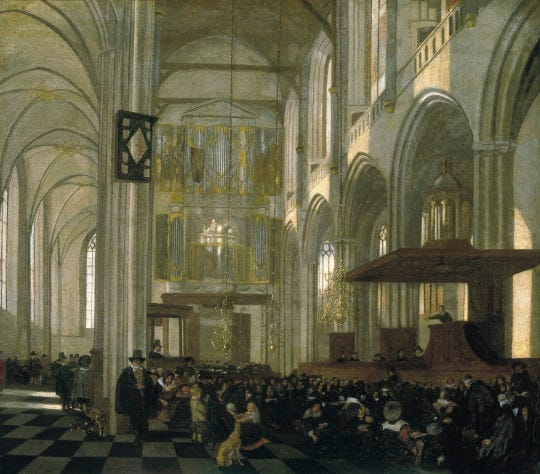
ANYWAY#2 - Here’s his biography. I like to read about the painters, it’s the least I can do to honor their work. Emanuel de Witte was born in Alkmaar around 1617. Son of a schoolteacher, he trained in Delft with the still-life painter Evert van Aelst. By 1636 he was registered in the painters’ guild in Alkmaar and in 1639 and 1640 is mentioned in various municipal documents in Rotterdam. He is again documented in Delft for the baptism of his daughter Jaquemyntgen in 1641 and is recorded in the painters’ guild of that city the following year. De Witte remained in Delft for approximately the next ten years. His early works comprise portraits, history paintings and mythological compositions, all of which reveal the influence of Gerrit Dou and the Utrecht school painters.
From 1650 onwards De Witte began to specialise in architectural paintings, in particular church interiors. Together with Gerard Houckgeest and Hendrick Cornelisz. van Vliet, he is considered one of the principal representatives of this genre in Delft. His early paintings are inspired by Houckgeest, but he soon developed his own style and technique, producing paintings of great quality. Around 1652 De Witte moved to Amsterdam where he married for the second time three years later. The city’s buildings, including the Nieuwe Kerk and the interior of the Portuguese synagogue, provided the inspiration for his paintings at this date, but only a few offer topographically accurate depictions as De Witte tended to take different elements and rearrange them in purely imaginary interiors, in contrast to Saenredam. De Witte also executed genre paintings, views of imaginary ports and, from 1660 onwards, scenes of markets. The unequal and variable quality of his work has been interpreted as reflecting his unstable personality and his last years were troubled by debt. De Witte’s only pupil was Hendrick van Streek.
Oh, fudge. Check that next to the last sentence. The unequal and variable quality of his work has been interpreted as reflecting his unstable personality and his last years were troubled by debt. Well, maybe, but it’s not a very generous way to interpret art. I wonder what this museum would say about Vincent Van Gogh? So I guess there’s a downside sometimes to knowing about your favorite artists. I’m unclear on how they can interpret paintings to show his personality was unstable, but critics can do anything they want. I choose to ignore them in this instance. Herr De Witte, your beautiful art survived! People are admiring your paintings, they hang in the world’s finest museums! Wherever you are now, know that your art made it.
His fish market painting bustles, doesn’t it? You can almost hear the buzz of the patrons and vendors.
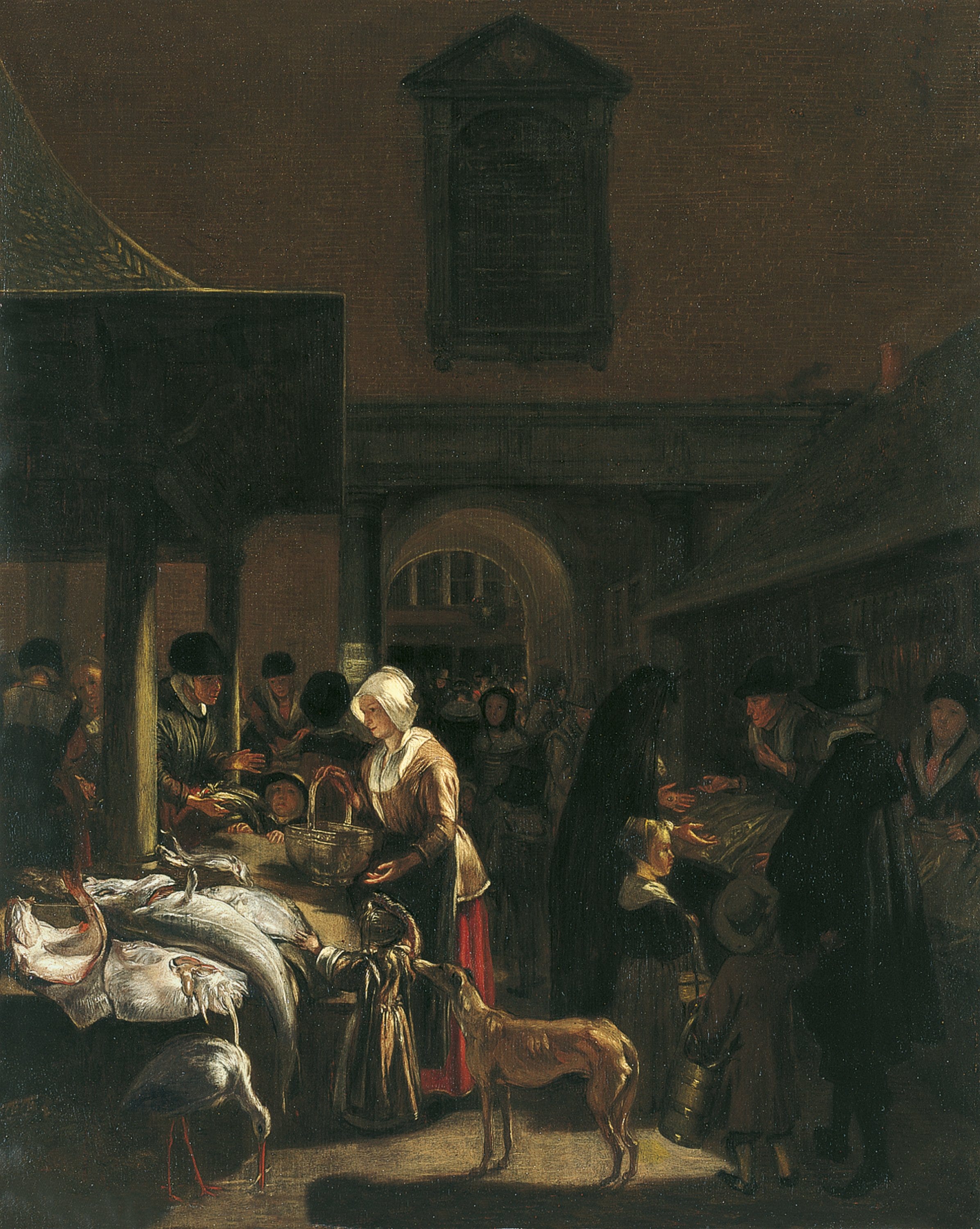
Again, the light is astounding. And the faces and movement. I love the man in the dark hat selling his wares. What size do you want, lady? I can cut it for you. Hey little girl, careful, don’t get the fish smell on your clothes.
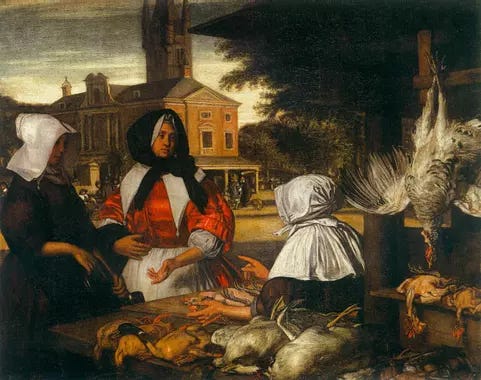
He also painted an excellent game market.
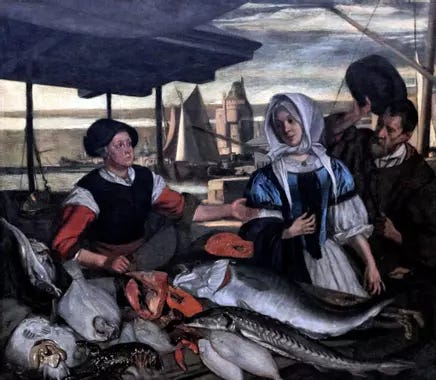
I’ll give you two more fish market ones, and I STRONGLY encourage you to click the one with the matron and child on the left. I’ve connected it to the National Gallery site, where those of you who’d like can zoom right in on his brush strokes. I had to see how he made that eel look so wet. You can’t tell much in the one I was able to download - the National Gallery wanted me to jump through all sorts of hoops - but I promise, CLICK and see how gorgeous it is in full detail.

If you’d like to see another one in the National Gallery, another church with a dog - I sort of love they took their dogs to church - click here.
And now to our Avoidance Art. I saw a sweet little painting on Tumblr, with a description below. The poster was kind enough to give me the biography, I didn’t have to go hunting this time. The painter is the sister of Czar Nicholas II, Olga Alexandrovna aka Olga Koulikovsky Romanova . What a life.
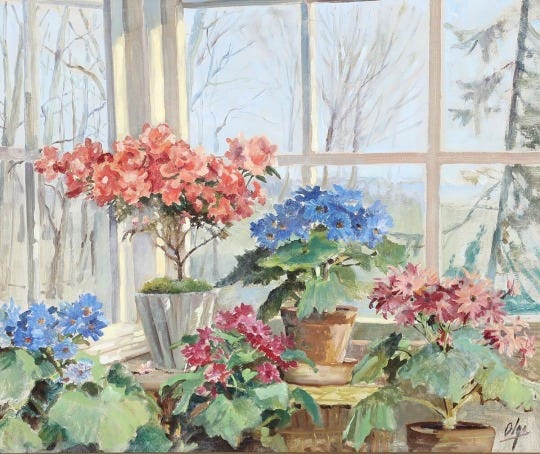
Grand Duchess Olga Alexandrovna of Russia (1882-1960) was the youngest child of Emperor Alexander III of Russia. Her older brother was Tsar Nicholas II. She was raised at the Gatchina Palace outside Saint Petersburg. Olga's relationship with her mother, Empress Marie, the daughter of King Christian IX of Denmark, was strained and distant from childhood. In contrast, she and her father were close. He died when she was 12, and her brother Nicholas became emperor. In 1901, she married Duke Peter Alexandrovich of Oldenburg, who was privately believed by family and friends to be homosexual. Their marriage of 15 years remained unconsummated, and Peter at first refused Olga's request for a divorce. The couple led separate lives and their marriage was eventually annulled by the Emperor in October 1916. The following month Olga married cavalry officer Nikolai Kulikovsky, with whom she had fallen in love several years before.
I sort of get it. When I am really disturbed, or sad, or just need to escape, painting is the way to go. I can short circuit the ruminating part of my brain and then it’s just the hand, the eye, the brush and how to move them together to get what you want on the canvas. Two hours can go by like five minutes.
Some artists even prefer different mediums depending on their mood - watercolors, feeling good, oils, not so good. But all beautiful.
I am pretty sure that Olga’s paintings don’t hang in a lot of major museums. (I’ve put some past her photos. Charming, and she definitely had talent!) Some have recently been sold on 1stDibs and Christies. How courageous, to channel your frustration, your fear, your longing for an old life that will never come back, into art and creation. My hat is off to you, Olga! The definition of gallant. You lived a full life in spite of your tragedies.


Here’s some more of her art.


While checking my Tumblr feed to find out who posted the biography, I found a new page - titled Mote Histoire, The Artists Deserve Their Credit. The curator posts paintings AND biographies. Glad I’m not the only one searching out the details. Serendipity!
Now off to buy soup and canned chicken.
I love Olga’s art. I have a little gallery of paintings in a popular coffee shop in town called The Honeymoon Cafe. It has a cable system for hanging 9 paintings. I’ve been hanging my work since July. I try to change out the paintings monthly. I don’t charge much, but I’ve sold quite a few so it has helped offset my art class fee as well as my online course. I’ve got to get something done by next week in a Christmas vein. I think I’m allowed to continue displaying because I try to add a seasonal decor to the shop besides what I like to paint.